
Mindsight
-
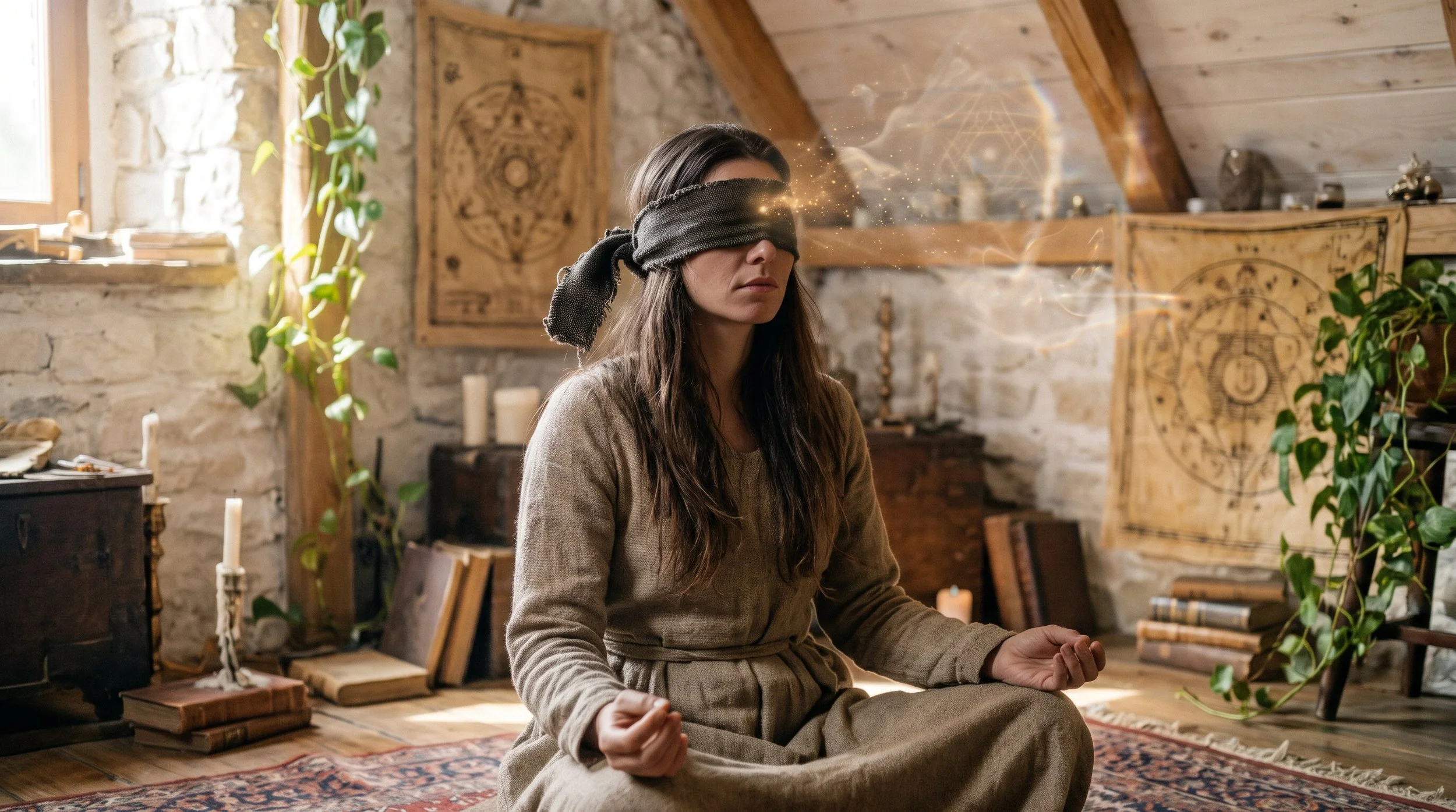
Mindsight means seeing without using the physical eyes. It is practiced wearing a thick blindfold mask, and the idea is that the brain can learn to receive visual information - colors, shapes and even writing - in a different way than usual. You will also find it called extraocular vision, eyeless sight or, in older books, paroptic vision.
Please note: the psychiatrist Daniel Siegel uses the word “mindsight” for a psychological method on empathy. That is something different from what we are talking about here.
-
The modern story begins in China. On March 11, 1979, a newspaper in Sichuan reported on Tang Yu, a boy of about twelve who could recognize words written on small pieces of paper held near his ear. Within a few months, dozens of other children with similar abilities were reported across the country, and Chinese scientists called it “extraocular image”. American intelligence services took an interest too: CIA documents on these experiments can still be found today.
Similar accounts exist in other countries and eras. In the Soviet Union of the 1960s, for example, there was much talk about a woman who said she could read with her fingers.
Today, schools and communities such as Vision Without Eyes, Mindsee and the Luminous Human Institute teach mindsight to children and adults. It is discussed on the podcast The Telepathy Tapes, and there are even competitions like the Psi Games, where people with extraordinary abilities are tested.
-
This is the most common objection, and honestly, that is often how it starts: a little light gets in and the eye adapts. But that is only the first phase, the one that teaches the brain to see in a different way.
Today there are testimonies of blind people, even without physical eyes, who can see with this technique (there is a good documentary called Superhuman 2). There are practitioners who tape aluminum foil onto their masks or wear three layers of material, and at the Psi Games the rules keep getting stricter: rigid masks, no turning the head. And yet, even as the barriers increase, people keep succeeding.
Mainstream science does not yet consider mindsight proven. So don't take my word for it: try it yourself, with curiosity and a critical mind.
-
The goal is not to see what you would see anyway without the mask. For many people it is about proving that human beings are capable of far more than we believe, and that we still know very little about how our consciousness and our reality work.
For me, the greatest benefit is this: by practicing, you train your brain to see in a different way and to look at everything from another perspective. The realized person is the one who can see all perspectives; they don't judge them, they understand them, and from that understanding comes transcendence. But first the brain has to leave its comfort zone, the one single way it usually sees.
In time, this practice may also help you recognize the energies that approach you during meditation, perceive frequencies and auras, and open the door to abilities like remote viewing.
-
Just a few simple things:
• A very thick, wide blindfold mask that covers your eyes and face well. I bought mine on Temu for very little; the official plastic mindsight mask is even better, but it is often sold out and more expensive.
• Sturdy colored cards that don't get ruined right away.
• Simple geometric shapes: triangle, square, circle and so on. Later on, a book too.
• A good, powerful flashlight.
• Optional: extra masks or eye patches to raise the level of difficulty.
Before training with my videos, practice on your own at least until you can tell colors apart with the mask on.
-
They are the windows that suddenly appear under the mask, through which you begin to see colors and everything else.
1. Two balls of light: they usually form at the sides of the eyes. This is where you will first see the colors.
2. Dots of light: more little dots appear all around, like the holes in Swiss cheese.
3. Large windows: those who have reached this point say that all these lights merge, and you can see the whole room in real time, as if you weren't wearing a mask at all.
To be clear: even the best have reached this last stage only rarely, and only after a lot of focused, daily training.
-
Go step by step. Your brain has been trained for years to see in one way only, so it needs a gentle manipulation, a little at a time. At first it will feel like you are cheating and fooling yourself, and that's okay.
• Keep your eyes open under the mask: you are not telling your brain to sleep or imagine, but to see in real time.
• Don't tighten the mask: let a little light in from the sides and the nose. More photons, more you see.
• Use sunlight: many people opened their windows of light for the first time outdoors, and they stay with you in the evening too.
• Indoors or in the evening, use the flashlight: first point it at the mask and see if two circles of light appear, then point it at the colors.
• Smile and move your facial muscles: more light gets in and the windows activate sooner. Do it anyway, even if it feels like cheating.
If you put on four masks in a dark room from day one, you will only get frustrated and give up. The people who can do that didn't start that way.
-
Start with blue and red, because they are very different. Take the blue knowing that it is blue, shine the light on it with the mask on and repeat to yourself: “this is blue, blue, blue”. Notice whether anything changes under the mask. Then do the same with red. For me, at first everything stayed black with red, but with blue the black became lighter, almost white. I still couldn't see the colors, but I knew which one was in front of me.
Don't train with similar colors, like green and blue, or dark ones like black and brown, which look too much like the darkness of the mask. Once you can tell two colors apart, add a third, for example purple.
The brain is a bit like a dog: once it has learned two or three colors, it will recognize all the others by itself. When you see colors well, move on to geometric shapes, then to text in books. When you feel confident, raise the level little by little: tighten the mask, add layers, put black tape near the nose, or practice with the lights off.
-
This practice is very tiring for the brain, because it isn't used to it. Instead of training for hours, do your twenty minutes, then stop and pick it up again later or the next day.
Consistency is what matters. If you skip days, the windows tend to close again, just like muscles at the gym. But starting again is always easier, because your brain remembers that it has already done it.
There will be better days and worse days: sometimes the windows are clear, sometimes blurry again. It depends on your mood, your energy, your subconscious and the light around you. Even a golf champion doesn't get the ball in the hole every day.
Relax and don't compare yourself to others. For some it comes right away, for others it takes longer, and that is not a failure. Even seeing 20 percent is better than 0, and this training is good for your brain and your other abilities.
-
Yes! You can start for free with my Mindsight mini course for beginners on YouTube (you'll find the videos on this page). It has a theoretical part with the origins, the materials and the technique, then a guided meditation to relax the mind, and a practical exercise where you try to see the colors and shapes I show you on the screen. Repeat it as many times as you like.
If you would like personal guidance, I also offer a private online Mindsight session for beginners via Zoom. You'll find it under Offering, in Private Sessions.
One last thing I always say: if you develop special gifts, use them with respect and integrity, never to spy on someone out of jealousy, revenge or for power. And always ask your heart, an open heart, whether you are doing the right thing.